Single tooth implant
One implant replaces one missing tooth and is restored with a crown.
Dent-O-Care · Dilshad Garden, Delhi
Replacement of one, several or all missing teeth with dental implants, planned around your oral health and the number of teeth to be replaced.
Treatment overview
Dent-O-Care is a Multi-Speciality Dental Clinic & Implant Care Centre. Implant treatment here is planned by Dr. Neiha Bansal, Dental Surgeon & Implantologist, around your oral health and the number of teeth to be replaced.
Quick answer
Dental implants are tooth-replacement restorations used to replace missing teeth. An implant is placed in the jawbone and, once it has settled, it supports a crown, a bridge or a full set of fixed teeth. At Dent-O-Care, implant treatment is planned according to your oral health, the number of missing teeth and your treatment needs.
An implant replaces the root of a missing tooth. The visible part of the tooth, the crown, is fixed on top of it. Because the replacement tooth is supported by the implant, it does not need to rest on the gums or be held by the neighbouring teeth.
Implants can replace a single tooth, several teeth, or all the teeth in a jaw. Implant-supported teeth are designed to work much like natural teeth and can help with chewing, speech and comfort; results vary from person to person.
Implant treatment may be considered when:
Whether implants are suitable is decided only after a clinical examination and an X-ray.
From the patient's concern, to the treatment, to its intended purpose.
The implant option depends on how many teeth are missing, the condition of the jawbone and gums, and your general health.
One implant replaces one missing tooth and is restored with a crown.
Two or more implants replace several missing teeth, with individual crowns or an implant-supported bridge.
For patients who have lost most or all of their teeth: implants and fixed teeth are planned for one or both jaws, customised to individual oral-health needs.
A full arch of fixed teeth supported on four implants, for suitable cases with multiple missing or failing teeth.
A full arch of fixed teeth supported on six implants, for suitable cases. Whether four or six implants are used depends on the jaw and the clinical assessment.
| Option | Usually considered for | What is fixed on the implants |
|---|---|---|
| Single implant | One missing tooth | One crown |
| Multiple implants | Several missing teeth | Crowns or an implant-supported bridge |
| Full-mouth rehabilitation | Most or all teeth missing | Fixed teeth for one or both jaws, planned per jaw |
| All-on-4 | A full arch to be replaced, in suitable cases | A full arch of fixed teeth on four implants |
| All-on-6 | A full arch to be replaced, in suitable cases | A full arch of fixed teeth on six implants |
The usual stages. Your own plan is explained at the consultation.
Your teeth, gums and medical history are reviewed, and your concerns and goals are discussed.
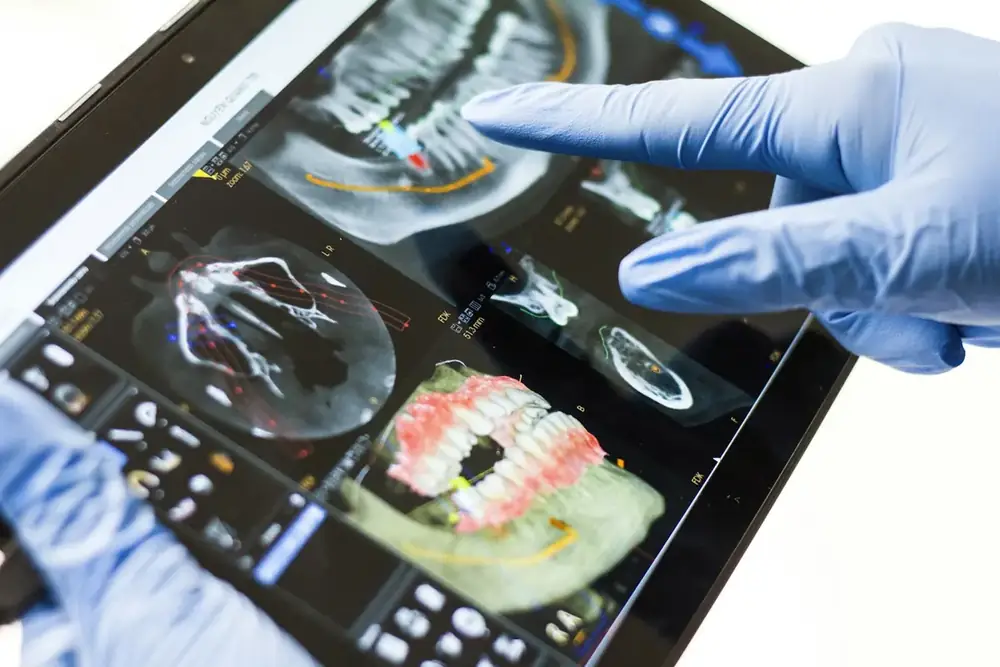
A digital dental X-ray helps the dentist assess the bone where the implant would be placed. The number of implants, their positions and the type of teeth are planned.
The implant is placed in the jawbone according to the plan.
The implant is given time to settle in the bone. How long this takes depends on your case and is explained beforehand.
The crown, bridge or full set of teeth is fixed on the implants and the bite is checked.
Review visits and home-care advice help you look after the implants and the gums around them.
Implant-supported teeth do not need to be taken out like a removable denture.
Replacing missing teeth can help restore chewing ability and speech clarity.
A single implant does not rely on the teeth on either side for support.
Crowns and teeth on implants are made to suit your smile.
With good home care and regular check-ups, implants can be a long-term tooth-replacement option. Long-term success depends on the bone and gums, general health, oral hygiene and habits such as smoking.
Benefits depend on your individual case, and results vary from person to person.
Implants are not suitable for everyone. Suitability depends on the condition of the jawbone and gums, your general health, any medical conditions or medicines, and oral habits such as smoking.
Where implants are not the right choice, other options such as a dental bridge or dentures are explained.
Suitability is always decided after an individual clinical assessment at Dent-O-Care.

Your dentist
Dr. Neiha Bansal
BDS · Dental Surgeon & Implantologist · Reg. No. A-12537
Full profile: Meet Dr. Neiha BansalTreatment cost depends on the individual dental condition, treatment plan, materials and procedures required. Contact Dent-O-Care for an assessment and treatment estimate.
Factors that affect the treatment estimate include:
FAQ
Common questions about dental implants at Dent-O-Care. For more answers, see the dental FAQ.
They are full-arch options in which a fixed set of teeth is supported on four (All-on-4) or six (All-on-6) implants. They are considered for patients with multiple missing or failing teeth, in suitable cases, after a clinical assessment.
Suitability depends on your jawbone, gums, general health and habits such as smoking. It is decided after an examination and an X-ray at the clinic.
Implant treatment takes place over several visits, with healing time between placing the implant and fixing the teeth. The expected timeline for your case is explained during planning.
Yes, in suitable cases. Full-mouth rehabilitation and All-on-4 / All-on-6 are options for patients who have lost most or all of their teeth.
Brush twice a day, clean between the teeth and around the implants, and keep your review appointments so the implants and gums can be checked.
Book your consultation
Book a consultation at Dent-O-Care to have your teeth and jawbone examined and to understand which implant option suits you. Dent-O-Care, 18-A Pocket B, near Bloom Field School, Dilshad Garden, Delhi.